Updated April 2026
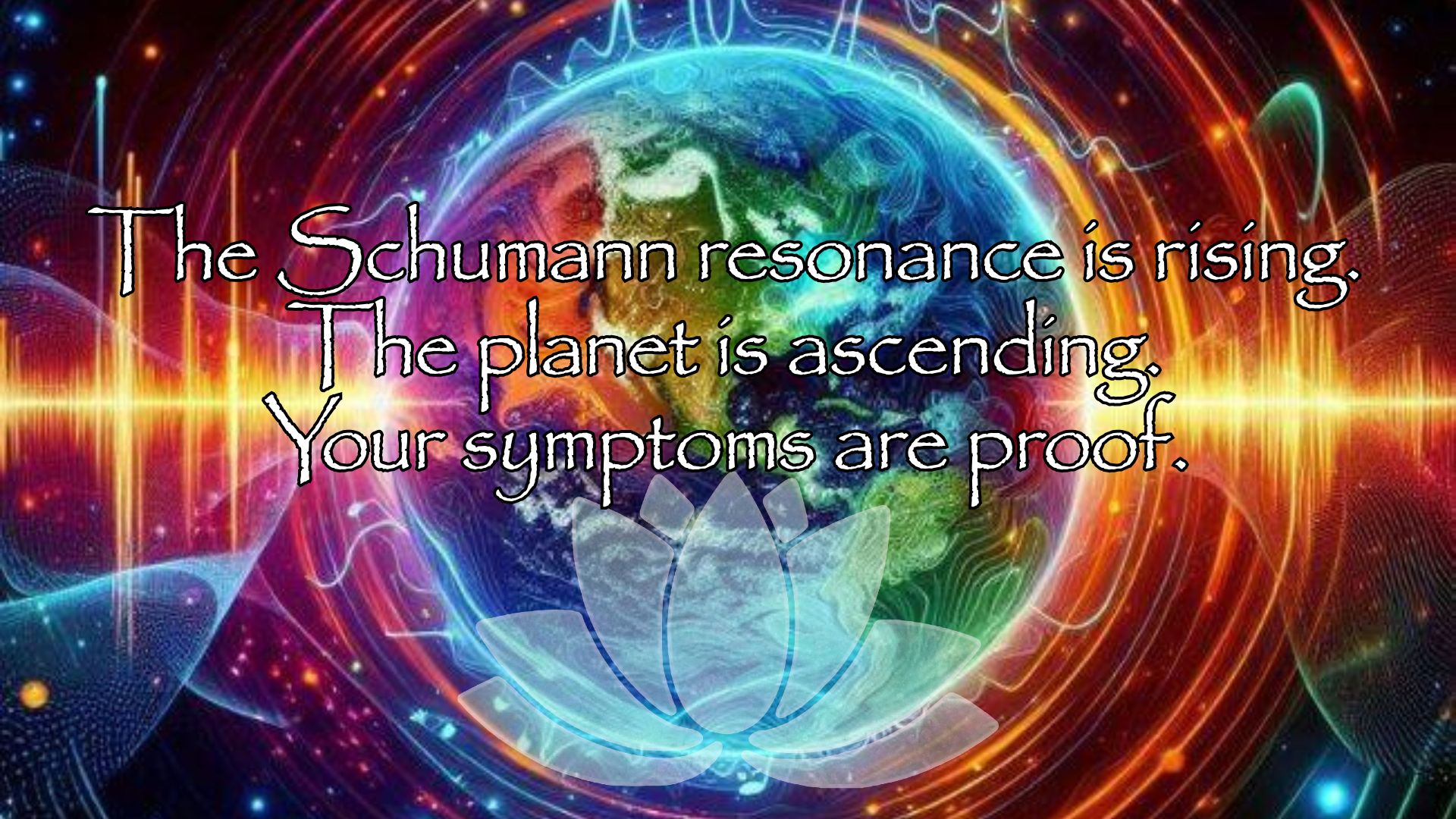
If you've spent any time in pagan, witchcraft, or New Age spaces online, you've seen the claim. It usually arrives as a graphic: a sine wave, maybe a lotus flower, the phrase "Earth's heartbeat" in a font that suggests enlightenment, and text says something like: The Schumann resonance is rising. The planet is ascending. Your symptoms are proof.
I wanted to believe in this, because it's a beautiful idea. The Earth has a frequency, and we're all attuned to it. The changes we feel aren't just personal chaos but a sign that something is shifting on a planetary level. We're resonating together.
The problem is that it's not true. Or rather: there's a real thing called the Schumann resonance, and then there's a mythology built on top of it that doesn't match what the science actually shows. And I think we owe it to ourselves to know the difference.
So let's talk about it. What the Schumann resonance actually is, whether it's rising, whether it affects us, and why this idea is so compelling even when the evidence doesn't hold up.
The Claim, Charitably Stated
Before anything else, I want to be genuinely charitable about what's circulating in spiritual communities, because I don't think the people sharing this are trying to deceive anyone. They're trying to make sense of the world. So here's the most coherent version of the Schumann resonance claim, stated as a claim and NOT a fact.
The Earth has a fundamental electromagnetic frequency of 7.83 Hz, sometimes called the "heartbeat of the Earth," generated by the interaction between the Earth's surface and the ionosphere. This frequency isn't coincidental: human alpha brainwaves, associated with relaxed and meditative states, fall in the 8–13 Hz range. We evolved in this electromagnetic environment; therefore, we're naturally synchronized with it.
Now the claim gets interesting. The Schumann resonance is rising. Different sources say different things: 8.5 Hz, 12 Hz, and higher. The cause is variously attributed to solar activity, collective shifts in human consciousness, or the planet moving into a higher vibrational state. And as the frequency rises, we rise with it. This is ascension, and it isn't always comfortable. You might feel dizzy, anxious, emotionally raw, and unable to sleep. These are ascension symptoms. Your body and consciousness are recalibrating. The shift can be difficult but ultimately positive, and it's permanent.
That's the claim. And before we examine it, it's worth sitting with why it resonates. (Pun absolutely intended.)
If you live with chronic anxiety, sleep disruption, or the pervasive sense that something is wrong with the world, this framework gives you an explanation that externalizes the problem. If you already believe consciousness and matter are interconnected, finding a real scientific term attached to that belief feels like validation. And if you feel powerless in the face of massive systemic problems, being part of a cosmic shift gives you meaning. You can transform the feelings of anxiety, sickness, or failure into a belief that you are sensitive enough to feel a planetary event, and you are an instrument detecting something real.
I understand the appeal completely. This idea takes genuine, difficult experiences and reframes them as sacred. The question is whether the science supports it.
What the Schumann Resonance Is
The Schumann resonance is documented. This isn't a case where the phenomenon is entirely fabricated. It's named after Winfried Otto Schumann, a German physicist who predicted its existence mathematically in 1952. It was first measured directly in the early 1960s, and it's been monitored ever since.
Here's the physics. Earth's surface is a conductor: a material through which electricity flows freely. The ionosphere, a layer of the atmosphere roughly 60 to 90 kilometers above Earth, is also a conductor. Between them sits the atmosphere, which is mostly an insulator. Two conductive shells with an insulating gap between them form what physicists call a resonant cavity: an enclosed space where waves can bounce back and forth and reinforce each other, much like sound echoing inside a cathedral. The Earth-ionosphere cavity works the same way, except electromagnetic waves bounce between the ground and the sky instead of sound bouncing off stone.
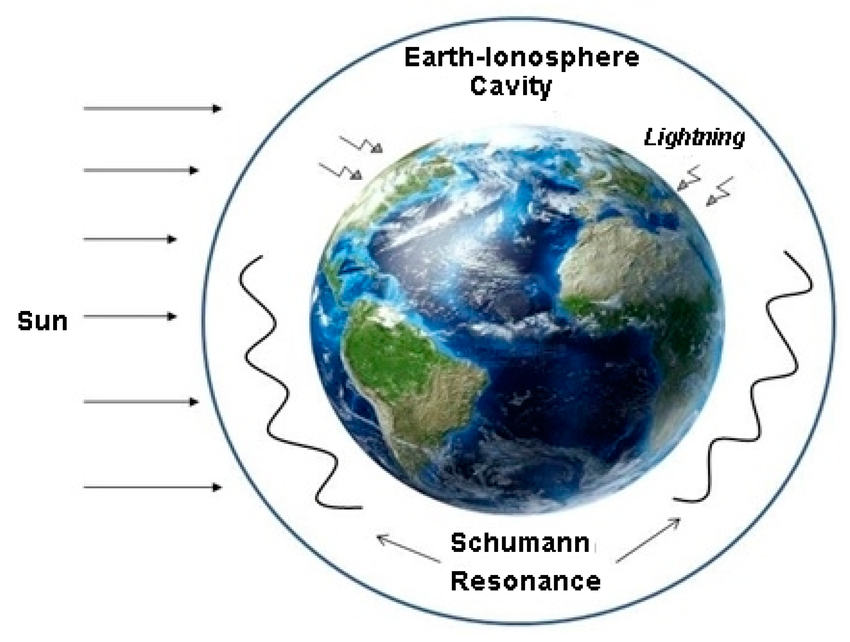
The energy source driving those waves is lightning. According to NOAA, approximately 100 lightning strikes occur somewhere on Earth every second. Each strike releases electromagnetic energy that travels along Earth's surface and bounces around in that cavity. Because the cavity is a specific size, only certain wavelengths fit neatly inside it. Those are the resonant frequencies. As mentioned, the fundamental frequency is about 7.83 Hz, with harmonics at roughly 14.3, 20.8, 27.3, and 33.8 Hz. All of these are part of the Schumann resonance; 7.83 Hz is simply the lowest one, the fundamental mode.
So when people say, "the Earth vibrates at 7.83 Hz," they're describing an observation: a standing electromagnetic wave in the space between the ground and the ionosphere, generated by lightning and measurable with sensitive instruments. It's real. It's cool. It's physics.
Does It Fluctuate? Yes. Is It Rising? No.
The Schumann resonance isn't a fixed, stable frequency like a tuning fork. It varies constantly based on seasonal changes in the ionosphere, time of day, solar activity, and local weather patterns. This is well-documented and entirely expected.
Real monitoring data from stations, like the Space Observing System at Tomsk State University, can be visualized as a sonogram: a graphical representation of electromagnetic oscillations over time, with frequency on one axis and time on the other. The Schumann resonances appear as persistent horizontal bands because lightning is always happening somewhere on Earth. Black vertical stripes are recording gaps. White vertical spikes are local lightning strikes. Narrow, unusually sharp horizontal lines are man-made interference from power lines and equipment.
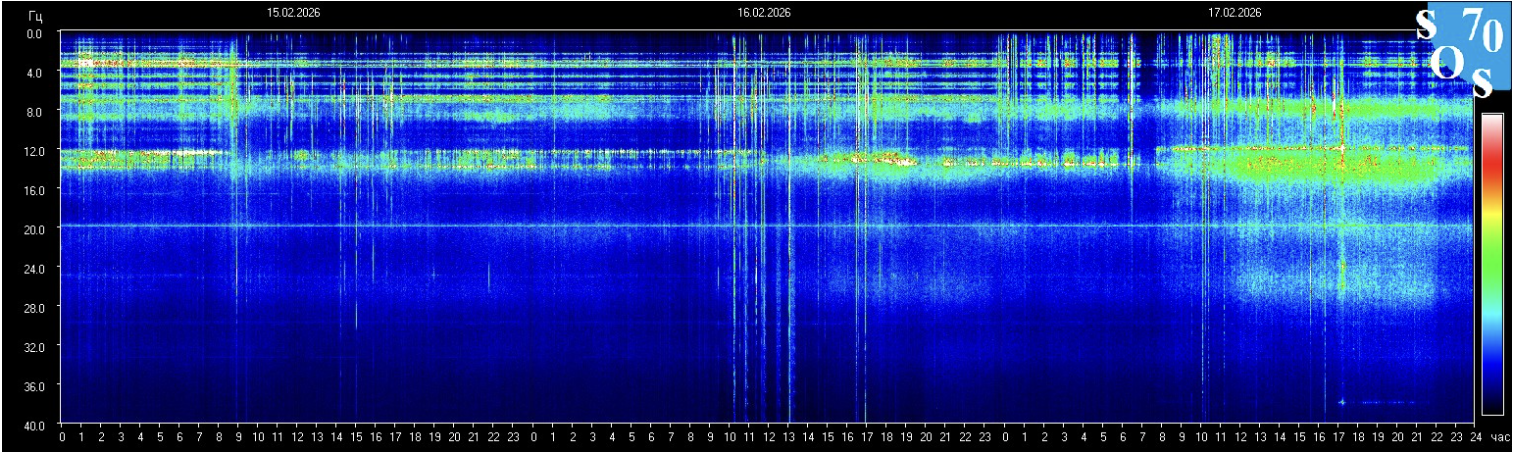
Example of Schumann Resonance data
This matters because when a screenshot of this data circulates online with a caption like "the Schumann resonance is spiking, something big is happening energetically," what you're usually looking at is a local thunderstorm. Or a power line.
These fluctuations are normal. They've always happened. There is no evidence that the Schumann resonance is rising in any permanent or meaningful way. It's not shifting from 7.83 Hz toward 12 Hz. A decade-long analysis from the Ukrainian Antarctic Station found that the frequency varies with the 11-year solar cycle but shows no permanent upward trend. The variations are cyclical, not directional.
When someone tells you the Schumann resonance is spiking, they usually mean the amplitude increased temporarily, or the frequency shifted slightly for a few hours. That is not the same thing as a permanent planetary shift. And to be clear: there is no scientific consensus, no peer-reviewed research, no monitoring program anywhere on Earth that has detected a long-term upward trend in the Schumann resonance frequency. If there were, atmospheric physicists would be very interested. They're not reporting it because it's not happening.
Can It Even Affect Us?
So now we can agree that the frequency isn't rising, but could even the normal fluctuations influence human consciousness or biology in some meaningful way? This is where many people land after the first part of the claim is challenged. Let's look at that.
First: the signal is extraordinarily faint. At Earth's surface, the Schumann resonance has a magnetic field strength of about 1 picotesla. A picotesla is one trillionth of a tesla. For reference, the Earth's geomagnetic field, the one that makes compasses work, is about 50 microtesla, which is 50 million times stronger. A refrigerator magnet runs around 5 millitesla, which is 5 billion times stronger than the Schumann resonance. We're talking about a signal so faint that detecting it requires extremely sensitive instruments in specially shielded locations.
A note on units, since both hertz and picotesla come up here: they measure different things. Hertz measures frequency, the rate at which a wave oscillates. Picotesla measures magnetic field strength. They're like the frequency and height of an ocean wave: two separate properties of the same thing. When we say 7.83 Hz, we're describing what the Schumann resonance is, how quickly it vibrates. When we say 1 picotesla, we're describing how strong it is.
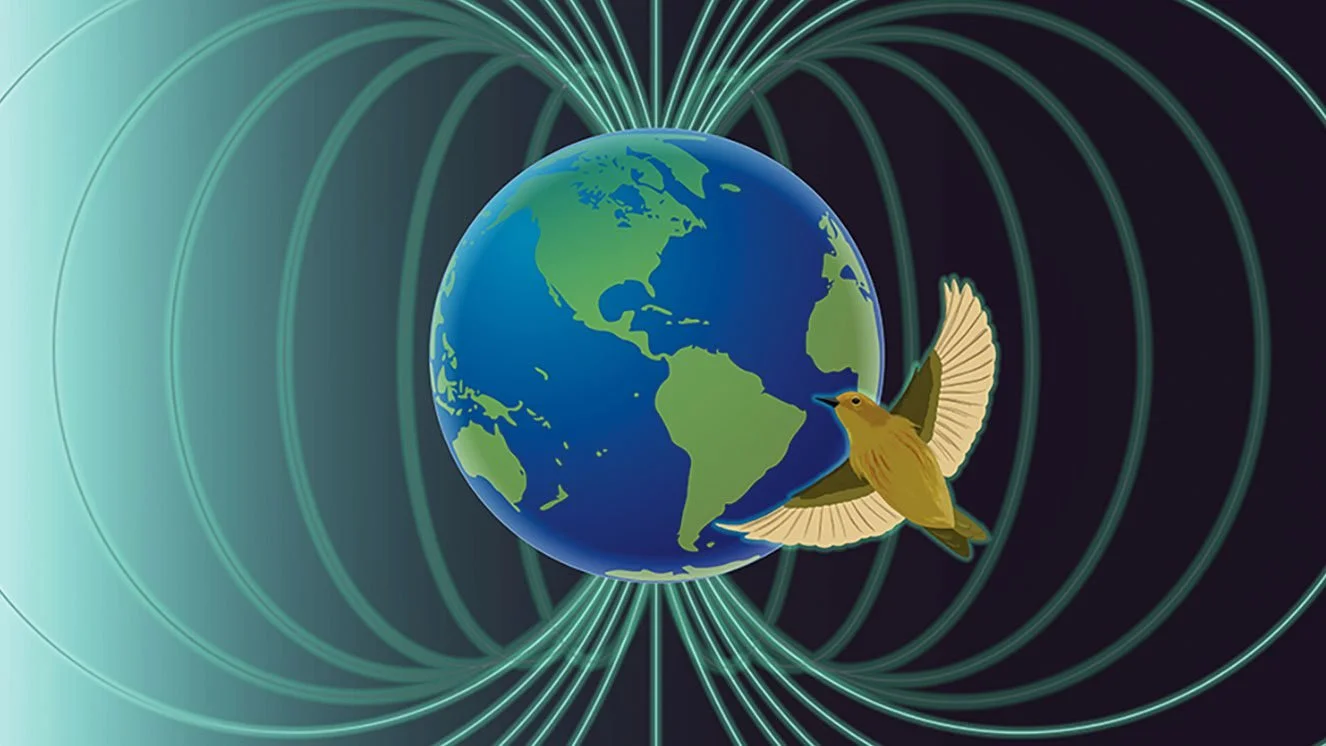
Humans don't have magnetoreceptors the way migratory birds do. We don't have electroreceptors like sharks. There is no known biological mechanism by which a 1-picotesla electromagnetic field at 7.83 Hz would penetrate the human body, interact with neurons, and produce measurable effects on consciousness or physiology.
Studies do get cited here, so let's address them. Two researchers whose work circulates in these conversations: Herbert König, one of Schumann's students, who in the 1970s observed similarities between the Schumann resonance spectrum and human EEG rhythms; and Rütger Wever, whose circadian rhythm experiments in the 1960s found that people isolated in underground bunkers shielded from natural electromagnetic fields experienced circadian disruption, which was partially reduced when an artificial 10 Hz signal was introduced.
These are real experiments, and they're genuinely interesting. But the field strengths used were much higher than those produced by the natural Schumann resonance, the sample sizes were small, and neither study tested whether a rising Schumann resonance causes ascension symptoms.
A 2025 systematic review found that most studies on the biological effects of extremely low-frequency electromagnetic fields carry a moderate-to-high risk of bias, leaving the overall certainty of the evidence low. The honest position is that it's an unresolved scientific question, and "unresolved" is a long way from "proven."
Then there's the brainwave overlap. Alpha waves are 8–13 Hz. The Schumann resonance is 7.83 Hz. Suggestive, right? The problem is that brainwaves and the Schumann resonance are not the same kind of phenomenon. Brainwaves are electrical activity generated by neurons firing in synchrony inside the skull. The Schumann resonance is an electromagnetic wave propagating through a planetary-scale cavity. The fact that they fall in a similar frequency range is a coincidence. It would be like saying that because your heart beats and a clock ticks at a rate of once per second, therefore the clock is driving your heart. Frequency overlap doesn't imply interaction.
How a Real Phenomenon Gets Transformed
The Schumann resonance entered New Age and alternative spirituality in the late 1970s and early 1980s, largely through the work of researcher Robert Beck, who linked the 7.83 Hz frequency to altered states of consciousness and healing. His 1980 paper appeared in the Journal of Borderland Research, not a mainstream scientific publication, but it was enough to get the idea circulating.
Before that, the Schumann resonance was simply an interesting piece of atmospheric physics. Once it entered the spiritual ecosystem, it transformed. It became the "heartbeat of the Earth." It became evidence for people who wanted to believe that the planet was alive in a measurable, scientific way. It became something we could attune to.

That's a beautiful metaphor. Earth is a living being with a pulse. We are participants in that rhythm. But somewhere along the way, the metaphor got confused with a mechanism. The resonance became not just a symbol of connection but a literal causal force. And it slotted neatly into ascension theology, the broader New Age framework in which humanity evolves into higher dimensions or states of consciousness.
It fits with the 2012 Mayan Long Count prophecies. It aligns with ideas that solar activity triggers shifts in consciousness. It fits with the Age of Aquarius. It spread through books, workshops, online communities, and eventually into pagan and witchcraft spaces because those communities are adjacent to New Age circles and because many of us are genuinely looking for ways to feel grounded in our earth-based spirituality.
There's also a specific pattern worth naming: how scientific papers get misrepresented in the process. A post will claim, "Scientists have discovered that the Schumann resonance is rising!" and link to a paper. If you click through, the paper says something like, "we observed a transient increase in Schumann resonance amplitude during a period of increased solar activity, consistent with known ionospheric disturbances." That is not the same claim.
Similarly, you'll see, "NASA has confirmed the Schumann resonance affects human consciousness," and the source will be a NASA webpage about space weather that mentions the resonance in passing among dozens of other electromagnetic phenomena.
This isn't usually intentional deception. Someone reads an abstract, misunderstands it, writes an enthusiastic post, and it gets shared. The telephone game begins. By the time it reaches you, the claim has traveled a long distance from what the original research actually said.
Why This Resonates (And What's Actually Going On)
The staying power of this idea isn't just about misinformation spreading. It's about what people need the idea to do.
Chronic anxiety, sleep disruption, and the sense that something is deeply wrong are real experiences that deserve real explanations. The Schumann resonance framework offers an explanation that isn't, "you're broken," "it's a chemical imbalance," or "see a therapist." It makes those experiences sacred. It makes you sensitive rather than symptomatic. It connects your suffering to something collective and cosmic.
That's not nothing. The desire for meaning in suffering is ancient, human, and valid.
But here's what I'd offer instead: climate anxiety is real. Political instability is real. Economic precarity is real. The 2020 pandemic was real, ongoing, and traumatic for many people in ways we're still sorting out. Social isolation, algorithmic manipulation, information overload, the sense of living through the slow deterioration of systems that were supposed to hold us, all of that is worth taking seriously and examining. Many of us are sensitive people living in genuinely difficult circumstances. The anxiety isn't imaginary. It has roots.

The Schumann resonance explanation relocates all of that onto a cosmic force, which can feel like relief. But it also obscures the actual sources of distress. If you believe you feel bad because of planetary frequency shifts, you're less likely to address the material conditions making you feel bad, and less likely to recognize that what you're experiencing might be a rational response to living through multiple once-in-a-lifetime crises.
I say this as someone who works from an animist framework. Animism holds that the world is full of persons: the Land, the River, the Tree, the Crow are participants in the world, not objects. That's meaningful and ancient, and it doesn't require pseudoscience to support it. The Earth can be sacred and alive without sending us electromagnetic signals about ascension. You can be deeply connected to the more-than-human world without needing a specific frequency-based mechanism to justify it.
Earth-based spirituality is actually a lot richer without this claim weighing it down.
Where We Land
The Schumann resonance is measurable: a standing electromagnetic wave in the Earth-ionosphere cavity, generated by lightning, detectable with instruments, and fluctuating normally under atmospheric conditions. It is not rising in any permanent or meaningful way. It is not causing ascension symptoms. There is no credible scientific evidence that it affects human consciousness or physiology at the intensities naturally present on Earth's surface.
The idea that it does these things is a beautiful metaphor, mistaken for a mechanism. It spread because it was comforting, because it offered scientific-sounding validation for genuine spiritual experiences, and because the people sharing it mostly believed it.
But the science doesn't support it. And that's okay.
You can still care about the Earth. You can still practice earth-based spirituality. You can still feel deeply connected to the planet and its rhythms.

If you're experiencing anxiety, dizziness, sleep disruption, or existential dread, those are valid, and they deserve attention. Maybe it's your nervous system responding to chronic stress. Maybe it's a medical issue worth investigating. Maybe it's the entirely rational response of a sensitive person living in a difficult time. You don't need the planet to send you a signal to justify the fact that you're struggling. You're allowed to struggle without making it cosmically significant first.
The actual science of how lightning creates standing waves in the ionosphere is genuinely extraordinary. There is no need to add mythology to it.
The Schumann resonance isn't the only frequency-based claim circulating in spiritual communities. 432 Hz as the "universe's natural tuning," Dr. Emoto's water crystal experiments, cymatics as proof that sound creates reality, the mechanics of "raising your vibration": these all follow the same pattern. Real physics, a spiritual framework layered on top, and a claim that the scientists don't want you to know about it. We're going to talk about those. Next up: 432 Hz and the tuning fork that's supposedly going to heal humanity.